Kitchen sink

meta
testing
Every feature I might use, in one place, to check it renders
Published

August 2, 2026

This post exists to verify that everything renders correctly. Delete it once you’ve checked.

It has draft: true in the frontmatter, so it appears in quarto preview but won’t show up on the published site or in listings.

Prose and inline formatting

Regular paragraph text at the default measure. Here is bold, here is italic, here is both, here is strikethrough, and here is inline_code() which should render in rust.

An external link and an internal link to the CV.

A footnote for an aside that doesn’t belong in the main flow.1 And an inline one.2

A blockquote. It should have a left border, italic text, and the muted grey.

Second paragraph of the same quote.


That was a horizontal rule.

Lists

Unordered:

  • First item
  • Second item
    • Nested item
    • Another nested item
  • Third item

Ordered:

  1. First step
  2. Second step
    1. Sub-step
    2. Another sub-step
  3. Third step

Task list:

Definition list, which is what the CV uses:

Term — a qualifier
The definition, indented beneath.

Math

Inline math like \(H = -\sum_i p_i \log p_i\) should sit on the baseline without disturbing line height.

Display math:

\[ \mathcal{L}(\theta) = \mathbb{E}_{x \sim \mathcal{D}}\left[ -\log p_\theta(x) \right] \]

An aligned block:

\[ \begin{aligned} \text{Attention}(Q, K, V) &= \text{softmax}\left(\frac{QK^\top}{\sqrt{d_k}}\right)V \\ \text{MultiHead}(Q, K, V) &= \text{Concat}(\text{head}_1, \dots, \text{head}_h)W^O \end{aligned} \]

A numbered, referenceable equation:

\[ \text{KL}(p \parallel q) = \sum_i p_i \log \frac{p_i}{q_i} \tag{1}\]

Referenced as Equation 1.

A matrix:

\[ A = \begin{pmatrix} a_{11} & a_{12} \\ a_{21} & a_{22} \end{pmatrix} \]

Code

A non-executing block, for showing syntax without running it:

def entropy(p, eps=1e-12):
    """Shannon entropy of a probability vector."""
    p = p / p.sum()
    return -(p * np.log(p + eps)).sum()

Another language, to check highlighting is language-aware:

quarto render && quarto publish gh-pages

An executing chunk with the code visible:

import numpy as np

rng = np.random.default_rng(42)
entropies = rng.beta(2, 5, 1000) * 4

print(f"mean: {entropies.mean():.3f}")
print(f"median: {np.median(entropies):.3f}")
print(f"below 0.5: {(entropies < 0.5).mean():.1%}")
mean: 1.169
median: 1.108
below 0.5: 14.2%

An executing chunk with the code folded behind a toggle, producing a figure:

Code
import matplotlib.pyplot as plt

plt.rcParams.update({
    "figure.facecolor": "none",
    "axes.facecolor": "none",
    "savefig.transparent": True,
    "text.color": "#888",
    "axes.labelcolor": "#888",
    "xtick.color": "#888",
    "ytick.color": "#888",
    "axes.edgecolor": "#888",
})

fig, ax = plt.subplots(figsize=(7, 4))
ax.hist(entropies, bins=40, color="#b04a24", edgecolor="none")
ax.set_xlabel("entropy (nats)")
ax.set_ylabel("count")
ax.spines[["top", "right"]].set_visible(False)
plt.show()
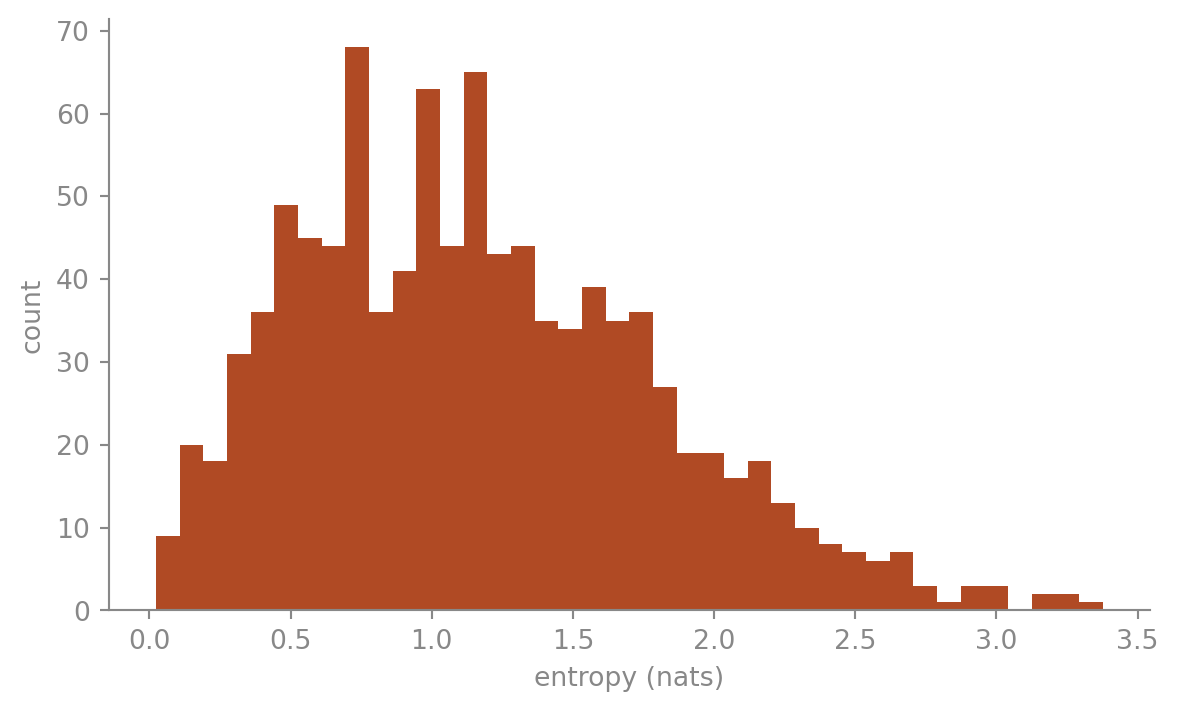
Figure 1: Distribution of attention entropy across heads

Figure 1 should be numbered, captioned, and clickable from that reference.

A chunk with the code hidden entirely, showing only output:

If you can see this line but not the code that produced it, echo: false works.

Tables

A Markdown table:

Method Params Accuracy Notes
Baseline 110M 84.2% Standard fine-tuning
+ pruning 62M 83.9% 44% smaller
+ distillation 62M 85.1% Best result

A generated table, to check dataframe rendering:

import pandas as pd

pd.DataFrame({
    "layer": range(1, 7),
    "mean_entropy": np.round(rng.uniform(0.2, 3.5, 6), 3),
    "dead_heads": rng.integers(0, 12, 6),
})
Table 1: Summary statistics by layer
layer mean_entropy dead_heads
0 1 3.221 4
1 2 1.911 9
2 3 1.261 3
3 4 2.932 3
4 5 2.744 10
5 6 1.851 7

Referenced as Table 1.

Callouts

Note

A note callout. Default styling, no title.

TipWith a custom title

Tip callouts take a title attribute.

Warning

Warning callout, for caveats that matter.

This one starts folded. Useful for long derivations you don’t want interrupting the main argument.

Citations

A claim requiring a source (Vaswani et al. 2017). Another with a page reference (Vaswani et al. 2017, 4). An in-text citation: Vaswani et al. (2017) introduced the architecture.

The bibliography renders below, assuming references.bib exists.

Layout

This is margin content. Whether it appears in the margin depends on your layout CSS — currently the margin column is collapsed, so it will likely render inline.

Two side-by-side blocks:

Left column content. Useful for comparing two things.

Right column content. Should sit alongside the left on wide screens and stack on mobile.

Long paragraph, for measure

This paragraph exists to check the reading measure at your current max-width. A comfortable line length runs somewhere between sixty and seventy-five characters, and the way to judge it is not by counting but by reading: if your eye loses the start of the next line on the return sweep, the column is too wide, and if the text feels choppy and your eye jumps too often, it is too narrow. Read this paragraph at normal speed and see whether anything catches. Then check it again on your phone, where the column will be constrained by the viewport rather than by the max-width, and where the font size matters more than the measure.

References

Vaswani, Ashish, Noam Shazeer, Niki Parmar, et al. 2017. “Attention Is All You Need.” Advances in Neural Information Processing Systems 30.

Footnotes

  1. This is the footnote body. It should appear at the bottom of the page with a back-link.↩︎

  2. Inline footnotes are defined where they appear, which is convenient for short remarks.↩︎